How to Start a Referral Conversation Naturally

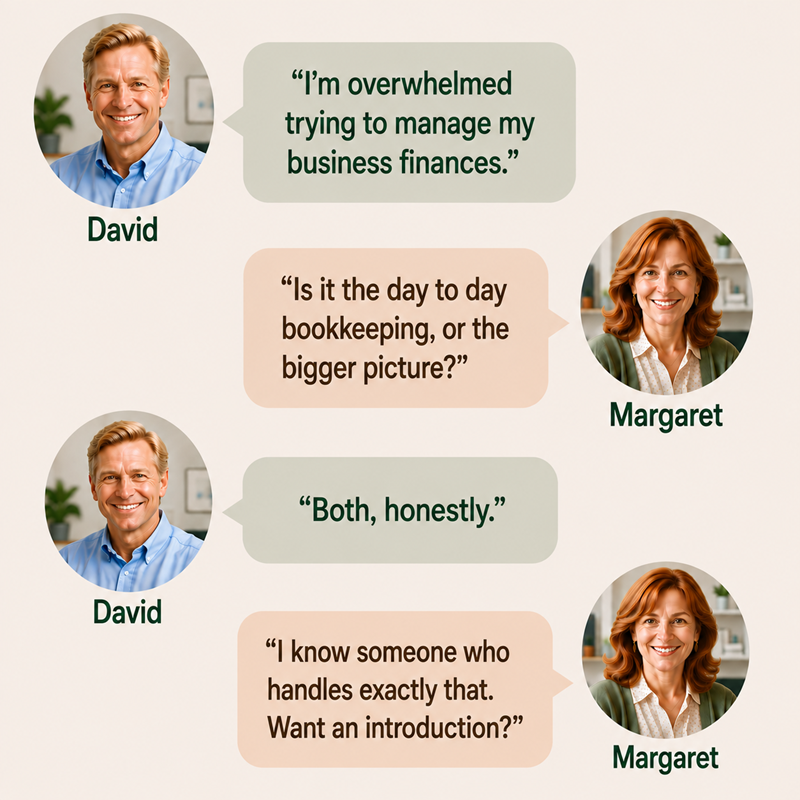
Two professionals shown in a conversation bubble exchange, illustrating how to turn an everyday networking conversation into a natural referral opportunity.Most professionals are happy to refer the people they trust. The hard part is knowing how to start that conversation.

The good news is it doesn’t have to be complicated. The most natural referral conversations don’t start with a pitch. They start with a question you’d ask anyway, like “How’s business going these days?” Then you listen carefully and ask one follow up question that fits what you actually heard.

Here’s how that looks in practice…

Margaret is a bookkeeper having coffee with David, a colleague who mentions he’s been overwhelmed trying to keep up with his business finances on his own.

Margaret knows a great CPA in her network. Instead of immediately recommending her, she asks, “Is it the day to day bookkeeping that’s getting to you, or is it more the bigger picture tax and planning side?” Read More

Mortgage Professionals: Is Your Brand Really Yours?

LinkedIn newsletter postIf you’re a mortgage professional, realtor, or title professional, you’ve worked hard to build your reputation. But here’s a question worth asking: if you left your company tomorrow, what would you take with you?

For many professionals in this field, the honest answer is much less than they think.

You have a spot on the company website. A corporate directory listing. A presence that looks like everyone else’s at the firm. The company controls what goes there, how it looks, and what it says. And when things change, that presence disappears.

That’s the risk of building your brand on borrowed ground.

Three Reasons Your Own Brand Presence Matters

  1. It differentiates you from everyone else at your company
    A corporate page gives every professional the same amount of space and the same format. It doesn’t reflect your values, your approach, or why clients trust you specifically. Your own website can say all of that clearly and in your own voice.
  2. It works for you before a client ever calls
    New clients are searching online and asking AI tools for recommendations. A personal website with strong, relevant content helps you show up in those searches and gives potential clients enough information to feel confident reaching out.
  3. It belongs to you no matter where your career takes you
    Whether you stay, move to another company, or eventually go out on your own, your website and its content go with you. You’re not starting over. You’re building on something that’s truly yours.

Your reputation is yours. Your brand should be too.

For the full story, including how one mortgage professional made this decision and what happened next, read the complete newsletter on LinkedIn. I’d love to have you subscribe to From Message to Momentum for future editions.


Exceptional Work Deserves to Be Seen

Is Your Expertise Actually Visible?

Your expertise deserves to be seenHere’s a belief that shows up often among experienced professionals: “I’ve been doing this for years. My results should speak for themselves, and the right clients will find me.”

It’s an understandable belief, and it’s also one of the most costly assumptions in business.

There’s a second version of the same problem that sounds like frustration: business owners watching competitors who aren’t more skilled or more experienced, yet attracting more attention, more traffic, and more new clients. It’s not happening because the competition is better. It’s happening because their marketing is doing a job that yours isn’t.

Both situations come down to the same thing. Experience that isn’t clearly communicated is experience that stays invisible. Read More

How to Stop Sounding Like Every Competitor

Your ideal clients are looking for you. Make it easy for them to find you.
Blue pencil standing taller than the yellow ones representing business differentiation
Russell Resources logo and https://writer.mnIf you want to stop sounding like every competitor, start here. Remove your name from your website or LinkedIn profile. Could that description belong to one of your competitors just as easily as it belongs to you? For many service providers, the answer is yes.

Here are three habits that make marketing blend in, and what to do instead.

  1. Leading with job titles instead of value
    Saying “I am a financial advisor” or “I am an IT consultant” tells someone what you are, not what you do for the people you serve. Titles are a category, not a value distinction. Lead with the outcome you deliver, not the role you hold.
  1. Listing features instead of outcomes
    Buyers are not shopping for features. They are looking for results, relief, clarity, or growth. When your marketing speaks to what your ideal client actually wants, it connects differently and stays with them longer.
  1. Using industry jargon your clients don’t use
    The language that feels natural inside your field often creates distance outside of it. If your ideal client has to work to understand what you mean, you have already lost their attention.

What to do instead

Speak your client’s language, not your own. What do they call the problem they are trying to solve? What does success look like to them? When your marketing reflects those answers, it stops sounding like a service description and starts sounding like a conversation they are already having in their own mind.

The goal is not to sound impressive. It’s to sound like the right fit for the right person.

When your message is that specific, the right clients will recognize themselves in it.

***

For the full story, including a real-world example of what generic marketing actually costs a business, read the complete newsletter on LinkedIn. While you’re there, I’d love to have you subscribe to From Message to Momentum for future editions.

SEO is not dead

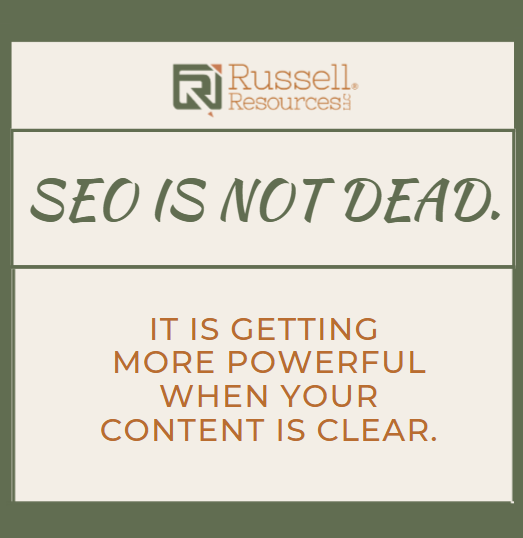
SEO and AI optimizationSEO is not dead. It is getting more powerful when your content is clear.

You may have heard that SEO is dead. I have heard it too. But here is what is actually happening: search is expanding, and the businesses with clear, trustworthy content are the ones showing up in more places than ever.

What SEO still does for small businesses

Search engine optimization helps your website show up when potential customers look for what you offer. Google continues to reward helpful, reliable, people-first content — and that has not changed. Strong site fundamentals, clear writing, and genuine usefulness still drive results. Read More

How to write better marketing content?

How to Write Better Marketing Copy PenWrite better marketing content by focusing on your customers’ problems and using their words.

Key steps for better copy 

  • Listen to customer language: use their words, not technical or marketing jargon 
  • Address their real problems: write about their fears and frustrations 
  • Make it conversational: write like you’re talking to a friend 
  • Keep it simple: avoid complicated words and long sentences

Good marketing copy sounds like your customers talking, not like a corporate brochure.

Read More

Should I use AI tools or hire a professional copywriter for my marketing content?

AI or Professional Copywriter?I get this question almost daily from service business owners who are stretched thin.

Here’s the reality: AI can help you create content faster, but it can’t understand YOUR specific clients, their pain points, or the unique way you solve their problems.

AI writes for everyone.
Professional copywriters write for YOUR ideal client.

When you use generic AI content without personalization:

    • Your message gets lost in the noise
    • You sound like every other business in your industry
    • Potential clients scroll past without engaging
    • Your expertise gets buried under bland, forgettable copy

Read More

The Power of Marketing for Boutique Firms

What is your superpower?Being a boutique firm isn’t a limitation—it’s a superpower. Whether you’re a specialized recruiter, business consultant, technology expert, home inspector or other, your focused expertise creates massive value.

Here’s what makes boutique specialists stand out:

Speed & Adaptability
► You pivot faster than larger competitors
► You implement changes without bureaucratic layers
► You respond to market shifts in real time
► Your solutions are customized, not commoditized

Read More